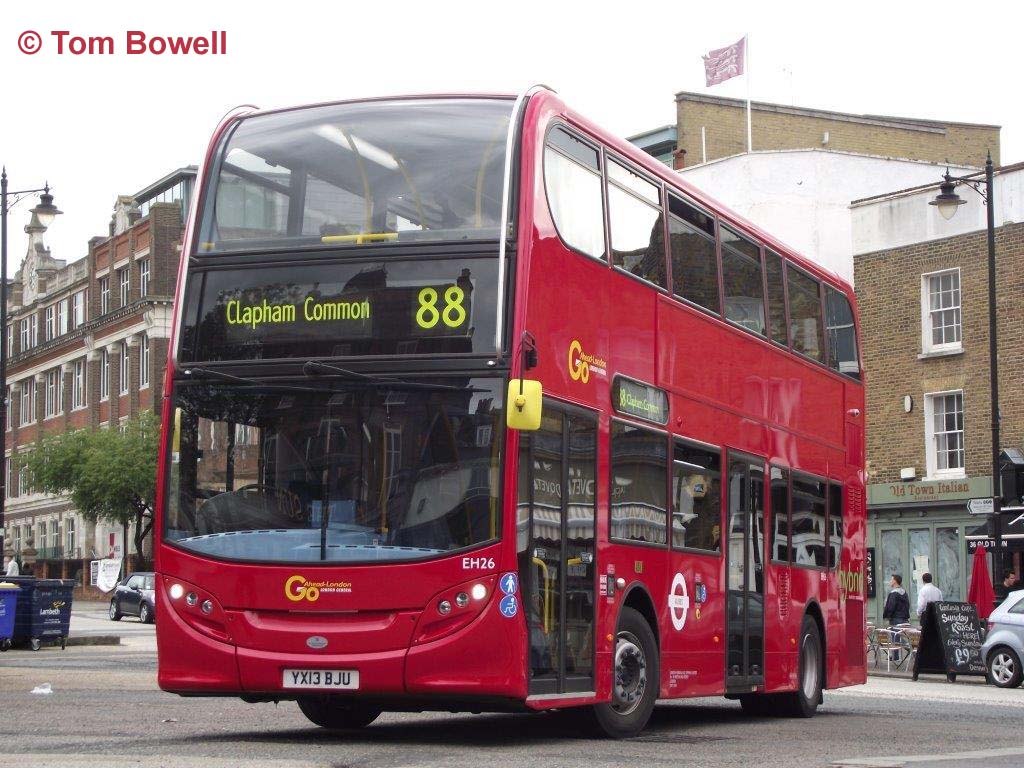
 | Photo © Tom Bowell. |
Home | Bus routes | Operational details | Service changes | Operators & Garages | Photo gallery
New hybrids originally ordered for route 87 were instead switched to the 88, so an update is in order. EH26 (YX13 BJU) poses at the stand at Clapham Common (Old Town). This location has just commenced "urban realm improvements" – a rather fancy name for costly cosmetic changes funded by TfL, which have often proved to do more harm than good. One effect here will be to reduce the capacity of the bus stand from 9 to 4 buses, which is not sufficient for the routes that currently terminate there!
| Photo © Tom Bowell. |
The EH allocation is fairly tight, and one other type that may appear to cover any shortfall is the standard version of the Envir400. E131 (SN60 BZC) was seen at Vauxhall Bus Station on 15 December 2010 when new.
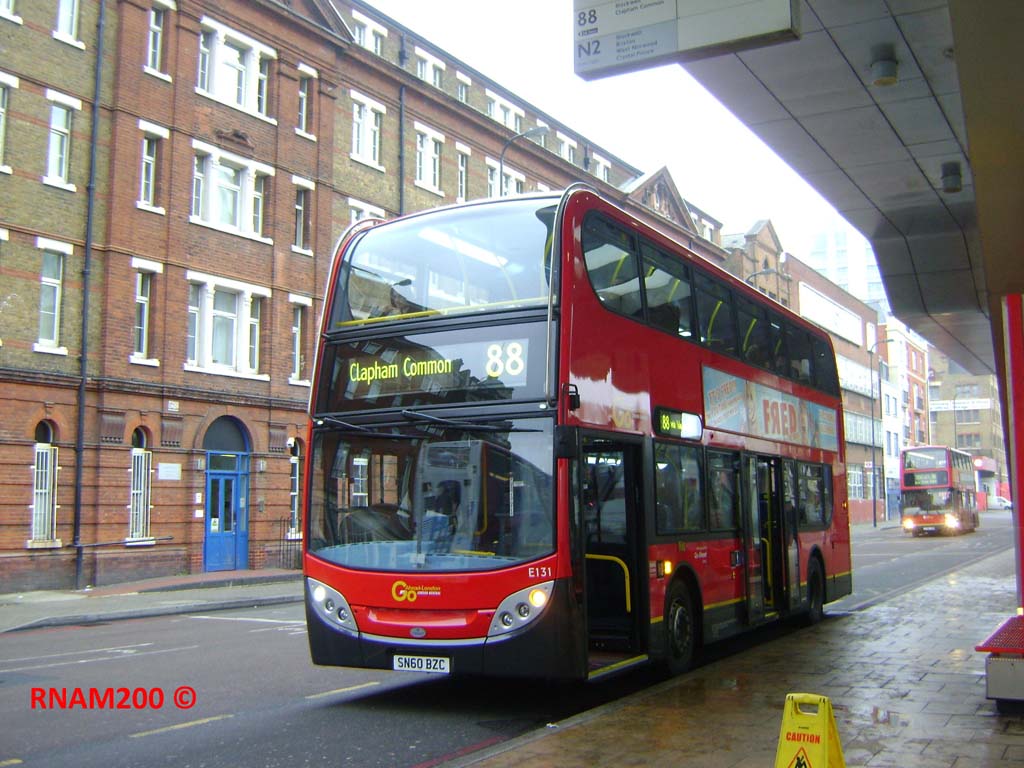 | Photo © RNAM200 (Robert Mighton). |
Recent years have seen a number of new routes or route extensions in central London. One of the first was the 88 which, bucking a trend that had been running for many years, received an extension across town. Previously the route had run from Clapham Common via Stockwell, Vauxhall, Marsham Street and Westminster to Oxford Circus, but severe restrictions on stand space in the latter area needed a solution, and the first step in that direction was the extension of the 88 to Camden Town. This in turn allowed the severely under used 135 service to be withdrawn, with the most useful links being maintained either by the 88 or the 134.
The 88 has had several types of Volvo buses over the years. The first arrived in the 1993 single deck craze in the form of Volvo B10Bs, bodied by Northern Counties, classified VN and kitted out with K-KLL registration marks rather vainly reflecting then managing director Keith Ludeman. However, inconsiderate parking around – of all places – the Department of Transport offices in Marsham Street, never mind the inadequate capacity of single deckers on such a route, saw their demise in 1997, when they departed for the fellow Go-Ahead company in Oxford. The registrations were also changed to K118-130 BUD, should anyone wish to trace them.
Meanwhile the 88 regained double deckers, in the form of Metrobuses. A feature noticed latterly on these was that many buses were displaying the Oxford Circus destination written in black marker pen on what was a yellow blank. The reason is that London General listed destinations alphabetically on the blind, so Oxford Circus and Clapham Common are well removed, which would tend to result in a degree of armache for the drivers winding from one to the other. However, there happened to be a yellow blank just below Clapham Common on the blind, and someone evidently took it on to convert this to an Oxford Circus destination! But, somehow, I don't think the reason for the Camden Town extension was lexicographic, even if it does eliminate this little difficulty quite effectively.
Volvo Citybuses meant for routes 133 and 196 also made occasional appearances. Later, the 196 was transferred to sister company London Central, due to driver shortages at Stockwell. Camberwell used Titans on the 196, and the plan was to use the VCs on the 88 instead. However this did not happen, and eventually the 196 came back to London General and regained the VCs. Thus the Metrobuses remained on the 88 until Volvo B7TLs started to arrive in 2000. Although these were meant for the 37 and 77A, they did initially tend to be put on the 88 in preference. The 88 was officially furnished with PDL class Tridents, though only 13 were ordered for a planned PVR of 11 that was increased to 15 to allow for the route extension. The route has since had a frequency increase and currently uses 22 buses in service, plus spares. Both these types had Plaxton President bodywork, but Stockwell subsequently amassed a sizeable fleet of Wright Eclipse Gemini bodied B7TLs, and now has Wright bodied B9TLs.
Traditionally the 88 was a much longer route. I do not propose to cover the history in detail, but the 1939 Greater London Bus Map (see www.busmap.org) shows the route running from Belmont to Acton Green via present day routes 280, 355, 88 and 94. I am advised that, unlike some other very long routes such as the 12, it did actually have a proper end-to-end service, at least on Sundays, though on weekdays buses from Acton Green more usually terminated at Clapham Common, Mitcham or St. Helier. The route continued to run between Mitcham and Acton Green until the 1980s, then having a short curtailment back to Tooting, before being cut down to run only between Clapham Common and Marble Arch from 1990, new routes 355 and 94 covering the remainder with short overlaps.
Navigation
| Previous | Next | |
| Chronologically | 189 | N29 |
| Numerically | 87 | 89 |
Photo Gallery | Bus route list | Operational details | Service changes | Operators & Garages