 | Photo © John Bennett. |
Home | Bus routes | Operational details | Service changes | Operators & Garages | Photo gallery
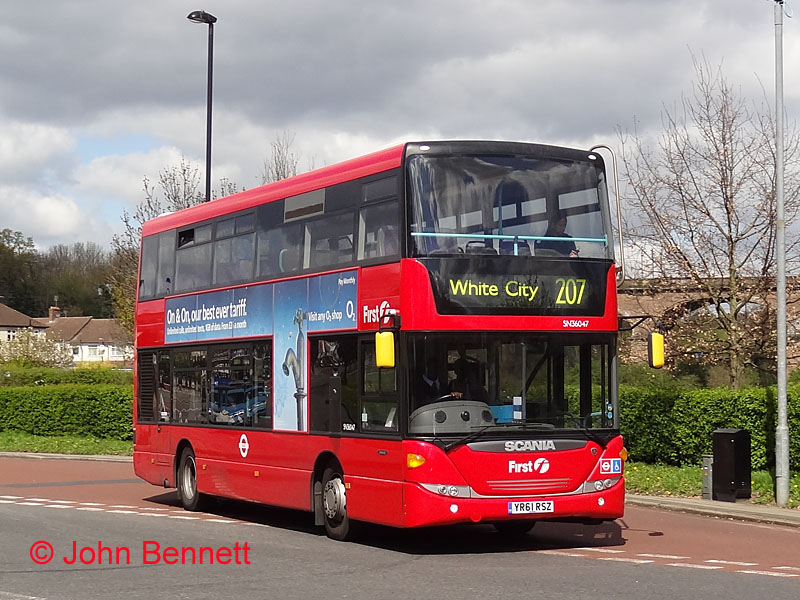
The conversion of route 207 back to double deck operation produced an unexpected vehicle type in the form of the Scania OmniCity. Although passengers in the area will be familiar with the type as neighbouring operator London United has a large fleet of them, these are the only ones with First London, and indeed will remain so as the type has apparently now ceased production. This makes First Centrewest the only London operator to have examples of buses from all four double deck chassis manufacturers (albeit counting the Wrightbus 'integrals' as VDL products, with which some may disagree!). (Go Ahead does have all four types, but not all in the same subsidiary.)
SN36047 was photographed on Sunday 15th April 2012, in the Uxbridge Road, right on the border of Hanwell and Southall. Hanwell Bridge over the River Brent is just to the right, behind to the left is Ealing Hospital, across the road behind the bushes is Brent Meadow and beyond that you can see a bit of Brunel’s Wharncliffe Viaduct (built 1836/7). There is a bus lane here allowing buses to jump traffic lights up by the hospital.
| Photo © John Bennett. |
The 207 has its roots in London United Tramways route 7, over much the same route from Uxbridge to Shepherd’s Bush and operated from Hanwell as well as Acton depot. This was replaced by trolleybus route 607 – still between the same terminals – one of the first such conversions on 15 November 1936, and operated from Hanwell. Like most trolleybuses, the 607 enjoyed a high degree of stability, finally succumbing to the diesel bus in 1960, becoming the 207.
The route carries high passenger volumes, as there are no major parallel rail alternatives – quite an unusual situation in London. Because of this there have long been aspirations for "rapid transit" of some sort. A return of trams may be wished for ultimately, but a start was made in the late 1980s and 1990s with provision of extensive bus priority along the route. An express version, numbered 607, was launched in 1990 to take advantage of this, though it has since been "dumbed down" with a lot of extra stops.
Soon after Ken Livingstone became Mayor of London, consideration started being given to introducing articulated bendy buses on certain high patronage routes, as these vehicles can carry more passengers than double deckers, albeit with the majority of them having to stand. Given the tram aspirations, the 207 was a natural contender for such vehicles, bendy buses being regarded by many as fake trams, though this overlooks the key asset of the modern tram operation which is the high quality of operation.
The 207 was duly selected for a trial of articulated buses in the latter part of 2001, aided by the fact that its operator, FirstGroup, had long been favourable to such vehicles and had some in its provincial fleet. 6 Volvo two-door artics were loaned to London, and operated a supplementary service between Hayes By-Pass and Acton, based at Greenford garage. Although popular on the continent, artics had not often found favour in the UK, their length making them unwieldy and slow. Or so it was generally believed, but the 207 experiment seemed to contradict this, with reports of buses whizzing ahead of the double deckers out there and yet carrying more than their fair share of the passengers!
The experiment was thus deemed a success, paving the way for approximately 500 articulated single deckers in London, beginning with the Red Arrow routes the following year. London’s models have been specified with 3 doors (4 was talked about), and in the event all were Mercedes Citaro Gs, apparently the only model able to meet TfL’s specifications, although a few demonstrators of other types were tried from time to time.
Unsurprisingly, when the opportunity arose, the 207 was duly converted to bendy bus operation. The previous roster of 48 double deckers, shared between Uxbridge garage and the former Acton tram depot, was replaced by one of 25 artics on the Shepherd’s Bush to Southall section, with the former Acton to Uxbridge section being renumbered 427, using 22 Tridents now based at Acton.
The routes were offered for tender early, apparently because First was keen to get artics on the route. Unusually, TfL included a site in North Acton with the tender offer, which must have made it easier for other operators to bid, including possibly some with no current base in the area. Nonetheless First retained the route, and the gamble paid off.
Unfortunately, planning permission for the North Acton site was rejected, and the conversion had to be placed in abeyance for several months, with vehicles being stored until an alternative site (in Hayes) could be found. The route split and conversion finally took place on 9 April 2005.
 | Photo © John Nicholas Bennett. |
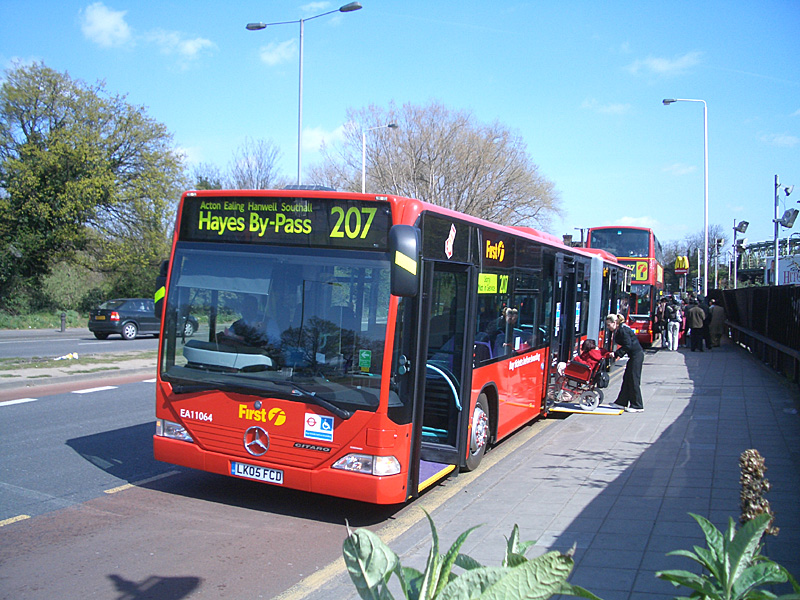
I have retained a picture of one of the Citaros, partly for the benefit of those who have never seen a wheelchair on a bus! Unfortunately, as is all too common, the ramp failed upon use. The passengers had to get off and most, if not all, got on the 427 that had pulled up behind. The photographer writes: “I don't know what was wrong, but I think it was the wheelchair ramp not returning back into the bus. The driver tried opening and closing the doors, kneeling and raising the bus. Some bloke tried pushing the thing back in (at least I assume that was what he was doing). Ah well, there are bound to be teething problems. At least it didn't catch fire.”
In practice the artics proved rather less popular with passengers than had been hoped, and this seems to have been a factor in Ken Livingstone losing the 2008 mayoral election to Boris Johnson who pledged to get rid of them by the end of 2011. In the case of the 207 this presented a problem in that the contract ran until April 2012, but it was tendered earlier than usual and First retained the route (despite being undercut by around 20% by another operator) and thus it was possible to introduce the new buses earlier, on 10 December 2011. Fittingly, the 207 was the very last artic route in London.
As to whether we will ever see the trams back, who knows? Ken Livingstone pushed hard for the tram scheme but very poor project management by TfL, in particularly the insistence that all motor traffic had to be diverted away at pinch points up narrow residential streets, thoroughly alienated the local residents to the point of Labour losing control of three local councils, so the scheme has had to be put on the back burner for now. But a scheme with slightly less "absolute" priority should still be possible. Trolleybuses have also been suggested; double deck trolleybuses have not been built for years, so that could be interesting! Either way, I am sure we have not seen the end of "rapid transit" developments along this corridor.
Navigation
| Previous | Next | |
| Chronologically | 455 | 360 |
| Numerically | 202 | 208 |
Photo Gallery | Bus route list | Operational details | Service changes | Operators & Garages