 | Photo © John Bennett. |
Home | Bus routes | Operational details | Service changes | Operators & Garages | Photo gallery
Northumberland Park garage was opened in the autumn of 1991 by Capital Citybus (now First London) in order to service newly won routes in the Walthamstow area. The 257 was not one of the original routes, but was added in October 1992, having been won from London Buses on tendering. The route operated from there until 1996, when another new base in Hackney (Waterden Road) opened, which was more conveniently located for the 257.
In a curious twist of circumstances, the 257 is now once again operated from Northumberland Park. The contract had passed to East London in October 2005, but was awarded to Go-Ahead's Blue Triangle subsidiary from October 2012. However, subsequent to the award but prior to its commencement came the surprise announcement that First was selling Northumberland Park garage, with all its contracts, to Go-Ahead, and it duly became part of London General from 31 March 2012. It then became apparent that the 257 would operate from there rather than Blue Triangle's base in Rainham, rather a long way off route. Of course, London General may well have known that a deal at Northumberland Park was likely when the tender was awarded.
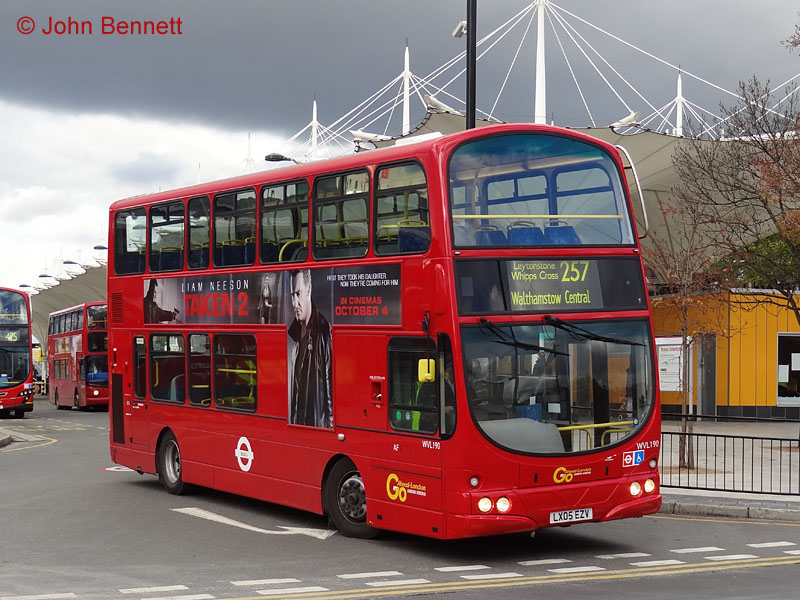
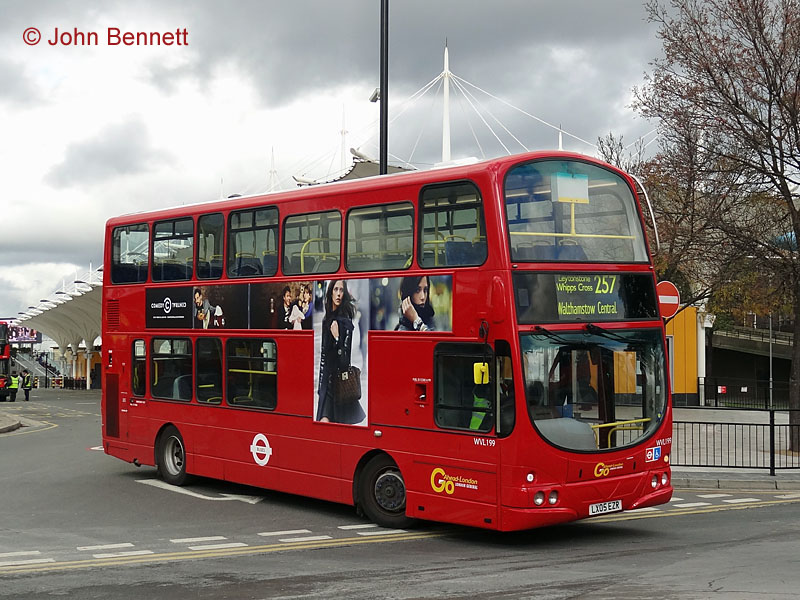
Some Volvo B7TLs with Wright Eclipse Gemini bodies have been transferred across from Putney garage, where they had operated on route 22, which gained new buses as part of a contract renewal. They have been internally refreshed and smartly repainted overall red complete with the LT roundel. Two photographs are provided here, both taken on Thursday 1 November 2012 at Stratford Bus Station, prior to the first pick-up on Great Eastern Road.
| Photo © John Bennett. |
The photos show respectively WVL190 and WVL199 (LX05 EZV and LX05 EZR). Both buses are from the same large batch new in July 2005 for the conversion from Routemaster operation of routes 14 and 22 from the 23rd of that month, but a slight difference will be immediately apparent from comparison of these photos. The last 20 vehicles, from WVL192 upward, were fitted with an upper-deck air cooling system, a new idea at the time but subsequently adopted as standard, which is housed above the staircase, the external evidence being shallow windows in this position. Behind WVL199 can be seen the new steps from the bus station to the new Westfield Shopping Centre.
 | Photo © John Bennett. |
The 257 was created on 19 November 1988 by taking over the northern part of trolleybus replacement route 262, between Stratford and Walthamstow, with a daytime extension to Chingford Mount. It was initially run by London Buses using Titans from West Ham garage (the original one!), and was transferred to Leyton the following year. As mentioned earlier, Capital Citybus took over in October 1992. A batch of newish Dennis Dominators was acquired second-hand from Southampton for the route, although a frequency enhancement the following September to cover the withdrawal of route 108 between Stratford and Wanstead saw them diluted somewhat by a medley of other types. In the last couple of years of the contract they were replaced by the more capacious Dennis Arrows, these having been displaced from route D6 by new Darts.
A new contract starting in October 2000 followed a trend that had been fashionable at the time of increasing the frequency by about 30% (from 6 to 8 buses per hour) but converting the route to single deck, although the new Marshall Darts were not ready for a few months. However, someone somewhere along the line appears to have done some decidedly duff calculations. The Arrows had a nominal capacity of 99 and the Darts 55, which is barely half; it is even worse if you consider the reduction in seating, from 77 to 28 – which, even taking into account the frequency increase, is still a reduction of 52%! Besides which, this only restored the frequency along Leytonstone High Road to that provided prior to 1993, when the 108 and 257 were both 4 bph, though with the 108 being single deck; at that time the 230 also supported the 257 between Walthamstow and Leytonstone.
Popularity of the service was such that, prior to the conversion, most departures in the peak hours and late afternoon from both Walthamstow and Stratford would be well laden, and huge numbers of passengers were getting left behind once the Darts arrived. And that is before we consider the crush loading conditions – when passengers complain about peak hour overcrowding on commuter trains, the conditions are rarely as bad as those that were being experienced on route 257. Indeed, the conversion was so disastrous that it proved to be the last, and after just 10 months the route reverted to double deck operation, initially achieved by deferring conversion of route 123 to low floor.
As mentioned at the outset, the next contract in 2005 was awarded to Stagecoach East London, using standard long wheelbase Tridents. The route could not pick up where it left off based at Leyton garage as there was no longer room there, so it was put into Stagecoach's base in Waterden Road, which was next to First's garage, but named Stratford (First's garage was named Hackney to avoid confusion!). Stratford garage closed in February 2008 to make way for the Olympic Park, and operation transferred to the replacement (new) garage in West Ham, where the route remained until handed over to London General.
Navigation
| Previous | Next | |
| Chronologically | X26 | 624 |
| Numerically | 253 | 261 |
Photo Gallery | Bus route list | Operational details | Service changes | Operators & Garages