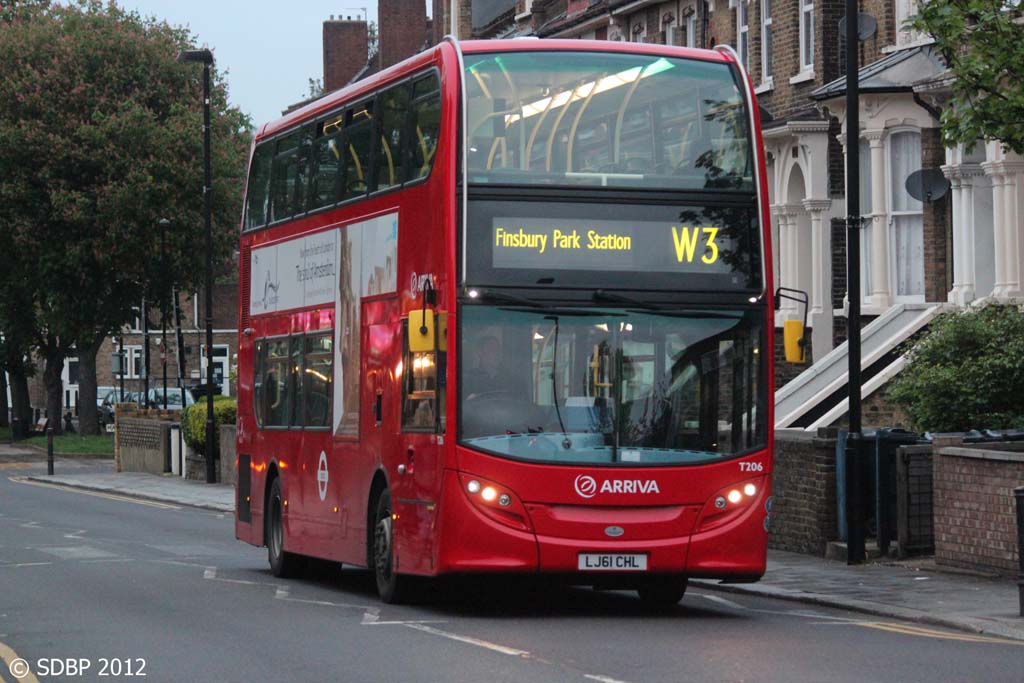
Route W3
25 October 2000

The W3 is reputedly one of the most reliable bus routes in London — although relatively short, it is lushly provisioned with a hefty peak allocation of 18 buses, perhaps to cope with Tottenham Hotspurs at certain times of year!

The W3 was one of the first London routes to sport a letter prefix, which was originally used to denote a flat fare route. Routes W1, W2 and W4 have fallen by the wayside (the present W4 is no relation), no doubt because they largely duplicated other routes over the same roads. But the W3 was different, having effectively been a renumbering of an existing route, the 233. It is of greatest use conveying the enormous numbers of tubeless Crouch End and Hornsey residents to and from their nearest railhead at Finsbury Park. It also gives a great view of London from Alexandra Palace, before dropping down to Wood Green and the glummer points east.


Photos by Matthew Wharmby.

DLA contrasts: Arriva made a number of modifications following experience with the first batch of 125 of these low floor DAF DB250LF/Alexander ALX400 double deckers. Although the changes were no doubt well meant, the older buses are in many ways preferable to the newer versions!

Demonstrating the original specification is DLA 124 (T324 FGN). Its long and low dimensions result in a very elegantly-proportioned bus, with the upper deck perfectly sectioned by the central staircase into tourists/scumbags! They ride (and sound) like a dream, and are very smart inside too. Seen at Wood Green headed for Finsbury Park on 22 July 2000.

This is not just any old DLA however, as this and DLA 125 were trialled in Ireland before delivery as DA 2/1 (99-D-53451/53440). Although popular with both Dublin Bus engineers and drivers, they were let down by the 'not quite low floor' specification. Much has been made of the fact that the DAF chassis necessitates a modest step up over the rear axle, unlike competing designs from Dennis and Volvo. The DAFs also differ by having sideways seats over the rear wheels rather than the forward/rear arrangement on the others. But the result is that you get a decent 'gallery' at the back of the lower deck, without having to stomach the contemptuous glares of the old folks who think you've taken 'their' seats, nor having to sit backwards and spend the journey staring each other in the face. In any case, the Trident and B7TL still have steps into the actual seats.

It was inevitable, was it not, that once London had almost the perfect modern opo bus, the specification would be spoilt. DLA 193 (W393 VGJ), of the new batch phased in for the W3 during 2000 in three stages (DLAs 159-165 in February, DLAs 190-195 & 199 (plus 124 & 125) in July and DLAs 210-213 in September), is totally inferior to the originals in every respect — from the short wheelbase and dumpy full-height configuration to the clumsy arrangement of two short bays amidships. The staircases were also moved forwards — a contentious issue. On the one hand it makes lower deck layout a bit easier, on the other it obliterates all but two decent seats upstairs and makes the bus look ill-proportioned with a huge swathe of dull panelling behind the driver. Seen at Wood Green exactly one month after DLA124, but going in the other direction.

Navigation
 PreviousNext
Chronologically40177
NumericallyU7W11

Photo Gallery | Bus route list | Operational details | Service changes | Operators & Garages