 | Photo © Brian Creasey. |
Home | Bus routes | Operational details | Service changes | Operators & Garages | Photo gallery
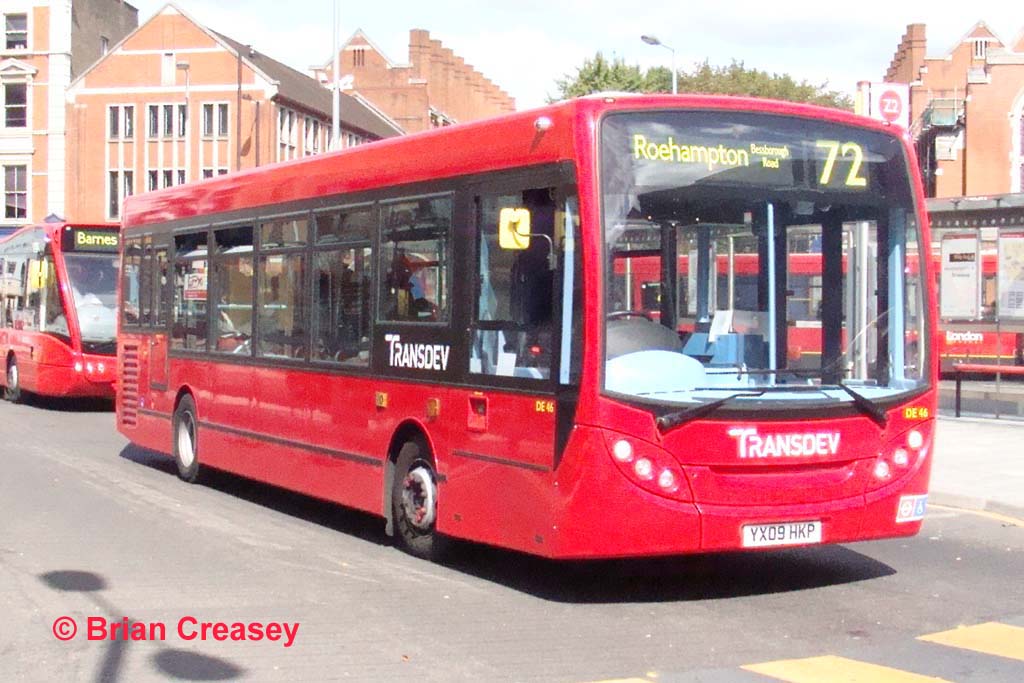
Having had the oldest of the DPS class of "short" (10.2m) Dart SLFs, which were rather down-at-heel and highly unreliable, the 72 has gained new buses for a new contract from September 2009. They are of the now familiar Enviro200Dart design -- which operator Transdev has thus far only taken in modest quantities. DE46 (YX09 HKP) is seen at the new (and temporary) bus "low level" station at Hammersmith on Thursday 10 September 2009. This bus station is only used by buses heading for Hammersmith bridge, plus route 266 which takes a unique routeing away from Hammersmith.
| Photo © Brian Creasey. |
Hammersmith Bridge was actually the reason for introduction of the DPS class in the first place. London United had previously been firmly committed to the longest version of the Dart SLF for its single deck fleet, which with a Plaxton Pointer (2) body measures 10.7m in length. However, not all routes can take such long vehicles. A batch of 10.2m Darts, unusually with Wright Crusader bodywork, was purchased for the H25 in 1996. More recently, Plaxton Pointers to 10.1m length were specified for routes 33 and 72; however, in this case the reason is less obvious, in that the cause is the weight restriction on Hammersmith Bridge.
Hammersmith Bridge has long been suffering structural problems and has been closed for lengthy periods on several occasions. However, it was decided to allow buses only to cross, subject to an onerous weight limit which restricted them to small single deckers. With the onset of low floor buses, the need to maintain an acceptable capacity on the buses, combined with the less efficient interior layout possible on the low floor version and the insistence on a second door, meant that buses would be over the weight limit. The limit was therefore raised especially for the purpose — but only just enough to permit a 10.2m version Dart to cross. Regarding them as "short" buses has always seemed a bit anomalous – indeed, some other operators which distinguish between lengths (notably First London) would have regarded them as "long." They are certainly a good deal longer than the 8.5m high floor Darts they replaced on the 72, even if they cannot boast many more seats, at 27 against 24 or 28! Incidentally, the removal of net cost contracts around this time resulted in the DPSs becoming the London United standard, as they were cheaper than DPs and still met London Buses' specifications.
The 72 is probably the nearest thing to a trunk route to cross Hammersmith Bridge these days; the need for single deckers more-or-less precludes such routes from having a major passenger-carrying role and the 72 is the only one that manages to get a significant distance beyond both sides of the bridge. Nevertheless, unusually, this is actually somewhat longer than the original route, which was from Hammersmith to Roehampton, running in a loop via Roehampton Lane and Dover House Road.
But the 72 was later extended tremendously and by the war managed to stretch out to Esher, via the Kingston By-Pass. There was also a Summer weekend service running to Chessington Zoo instead. Additionally the routes were extended to Shepherds Bush and East Acton, albeit via Westway, and on Sundays via Western Avenue to Wembley, covering for routes 187 and 79! What has happened subsequently was pretty predictable, with the weekend variations being abandoned soon after. Then buses were diverted along Du Cane Road in East Acton, and to run through the new, awkwardly located, Alton Estate in Roehampton, and later the East Acton terminus was extended slightly from Du Cane Road to Brunel Road, replacing the 295.
The section between Tolworth and Esher was withdrawn without replacement, although on Sundays the route was extended to serve Chessington Zoo once again. However, in 1991 the section south of Alton Estate was transferred to the 265, just in time for the start of the Hammersmith Bridge troubles. The closures of Hammersmith Bridge caused no small problems for the 72. Other routes terminating in Hammersmith were simply curtailed to the other side of the bridge, but because it is a through service the 72 (and N72) had to be sent on a lengthy diversion via Putney Bridge.
Navigation
| Previous | Next | |
| Chronologically | 184 | 344 |
| Numerically | 71 | 73 |
Photo Gallery | Bus route list | Operational details | Service changes | Operators & Garages