 | Photo © David McKay. |
Home | Bus routes | Operational details | Service changes | Operators & Garages | Photo gallery
The conversions of the last few articulated routes in London back to double deck are gathering pace, as the Mayor of London's 'end-of-2011' deadline rapidly approaches. I have two to deal with in these pages, the other being the 453, but one will suffice for this update.
The 73 had the biggest vehicle allocation of any London route in the latter days of Routemasters, and was one of the largest artic routes as well. However, its conversion back to double deck has been much more modest, perhaps because it gained a complementary parallel route (476), which doesn't apply to some of the other routes. Indeed, most unusually, the peak vehicle requirement, at 51, is now lower than before the artics were introduced, trailing routes 38 (70 buses) and 25 (59).
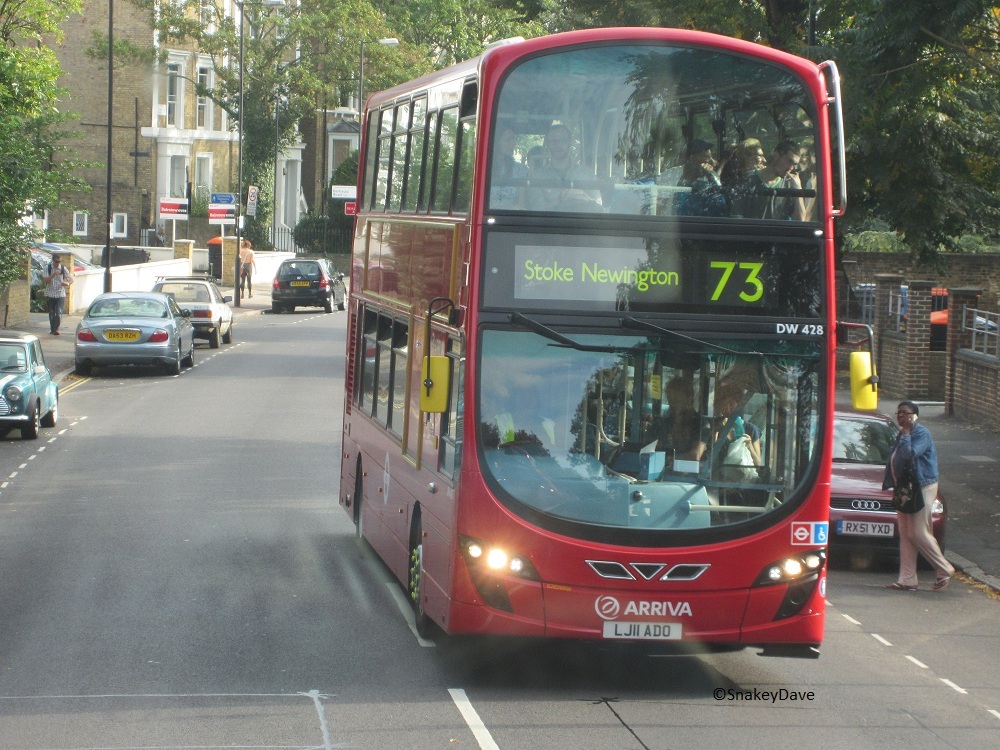
The bulk of the 73 allocation is made up of new Wright Gemini 2 DLs, and DW428 (LJ11 ADO) was seen in Albion Road, nearing the end of the journey at Stoke Newington, from a southbound bus on the first day of resumed double deck operation, 3 September 2011. There seem to be plenty of passengers who managed to find the stairs, with or without the aid of TfL's slightly patronising publicity telling people how to use a double decker!
| Photo © David McKay. |
And then – spot the difference! Almost indistinguishable externally, HV41 (LJ11 EFM) is actually a very different machine indeed. The DWs have conventional diesel engines and are on VDL SB300 chassis, but the HVs are hybrid drive vehicles on a Volvo chassis – the inclusion of a Volvo badge on the front perhaps the only obvious distinguising feature, unless you note the class code or the position of the upper deck windscreen handrail. Some differences can also be seen around the engine. This was seen at Newington Green, just a little further along the same southbound ride as the previous photograph. These buses make up around a third of the route 73 allocation.
 | Photo © David McKay. |
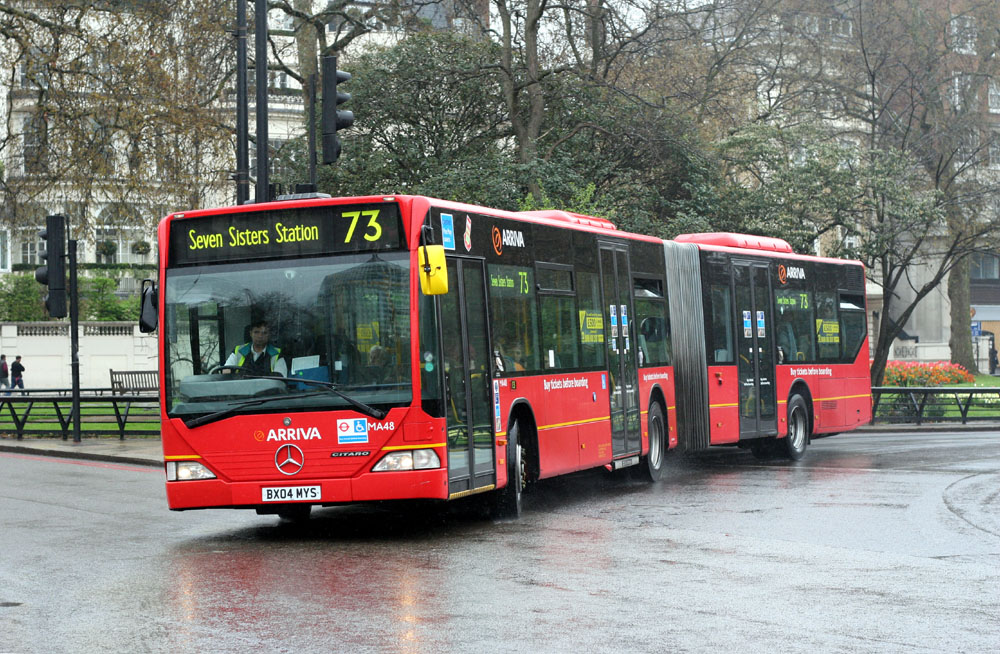
Again I have been asked to retain a photograph of an artic on the route, to remind us what they looked like – and it was a rather good picture anyway. The Mercedes Citaros were introduced on 4 September 2004 to coincide with a new operating contract. There was a bit of a Routemaster cull on that day, with routes 9 and 390 also converting from crew to one person operation, albeit using double deckers. The 73 artic PVR varied between 42 and 43, one of the more drastic reductions; TfL got into hot water after issuing some advertising with the theme "getting better from every angle," which various objectors successfully pointed out to the Advertising Standards Agency was hardly true, with a lower frequency, longer journey times (compared with Routemasters) and far fewer seats. Showing its articulation to good effect, MA48 (MX04 MYS) turns out of Park Lane onto the Marble Arch roundabout on a 73 journey to Tottenham on 23 April 2006.
 | Photo © Lee Whitehead. |
Note the destination of Seven Sisters. Although the "official" terminus of the 73 has long been Stoke Newington, it had for many years been the custom to extend a substantial portion of the service to Tottenham (AR) garage for crew changes, this being where the route was based. In Routemaster days they actually ran to Tottenham, The Swan, but with the conversion to artics the vehicles could not be maintained at AR, so the vehicle allocation had to be moved up the road to a new garage at Leeside Road, Edmonton (LV). Buses starting from LV would not conveniently be able to serve the first stop at Tottenham Swan, and had to start at Seven Sisters Station instead. Instead of allowing such an anomaly to persist, TfL cut back the entire service in both directions to this point, even though most journeys – including all northbound journeys, as well as many southbound daytime journeys starting from AR – still ran past The Swan!
All this resulted in a most unusual anomaly for London, in that many journeys, including the entire northbound morning peak service, terminated short at Stoke Newington. During peak hours all buses were needed in service between Stoke Newington and Victoria so, after the last bus had run out at 0817, there was no service north of Stoke Newington until the first bus ran in at 1001. There was a similar gap in the afternoon. On Sunday mornings a further variation existed, when three buses ran to and from Stamford Hill garage for reliefs!
However, all this has now ended. With the end of artic operation the possibility of re-allocating the route to one of the more traditional garages nearby was opened up. AR had been pretty much refilled with other routes in the meantime, so this time Stamford Hill (SF) garage was selected – a garage that had for some years been mothballed, but has now well and truly come back to its own. SF is also somewhat nearer to Stoke Newington than AR, obviating the need for trips to Seven Sisters, so the whole service has been cut back to Stoke Newington, which is probably what TfL really wanted all along anyway. However, that does mean quite a big reduction in service between Stoke Newington and Tottenham, putting extra pressure on other routes. The 476 maintains a through service to many of the places served by the 73, though it only runs as far as Euston.
Going further back, a further interesting variation was evident on the Routemaster timetable. As can be seen, that had short workings in both directions terminating at Tottenham Court Road from the north and at Oxford Circus from the south, often with two such short workings in the same gap between through journeys. Although partly no doubt to create a more efficient duty schedule, this reflects the way the 73 caters for two distinct markets – the obvious market from Stoke Newington and Newington Green into the West End, but also commuter traffic from Victoria station to Oxford Street.
This latter market is particularly interesting, since it was also the market aimed at by the first Red Arrow route, the 500. Victoria was linked to the western end of Oxford Street by the 2 group, and to Oxford Circus by the 25 via Davies Street/New Bond Street. However, there was no direct route running along Oxford Street itself – the 73 at this time diverted at Hyde Park Corner to Hammersmith, Richmond and Hounslow. To correct this deficiency, new Red Arrow route 500 was introduced from 18th April 1966, running on Mondays to Fridays only from Victoria via Hyde Park Corner and Park Lane, and then in a loop via Brook Street, Hanover Square, Oxford Street and Marble Arch and back to Victoria. During peak hours, the route ran betwen Victoria and Marble Arch only.
This was in fact a very significant milestone in London's transport history. At that time, most buses were crew-operated double deckers, and single deckers were only used on routes with light loadings or restrictions such as low bridges. The 500, however, introduced the concept of one-person-operated, single-deck "standee" buses on busy corridors – the same principle as the artics. 14 Strachens-bodied AEC Swifts formed the XMS class, which LT called 'Merlins,' having just 25 seats, but room for 48 standees. A flat fare was charged, passengers depositing 6d (2½p) coins into a slot machine. Although the buses were not hugely successful from a mechanical point of view, it is a pity that none were saved for preservation, given their significance.
A weekend service was soon added, although the Sunday service was withdrawn again in 1973, when the route was also diverted to run along Oxford Street in both directions. The peak hour service was extended to Oxford Circus the following year. The 500 lasted until 1988, when the 73 was diverted to Victoria to replace it, the section to Hammersmith being replaced by route 10. (The section of the 73 beyond Hammersmith was largely replaced by the 33 in 1967.) Thus the artic conversion of the 73 has reintroduced the standee mode of operation to the Victoria-Oxford Street corridor. Although it worked fairly well at that end, passengers at the northern end of the route, making long journeys into central London, were less impressed!
Navigation
| Previous | Next | |
| Chronologically | 25 | K5 |
| Numerically | 72 | 77 |
Photo Gallery | Bus route list | Operational details | Service changes | Operators & Garages