 | Photo © Anthony Or. |
Home | Bus routes | Operational details | Service changes | Operators & Garages | Photo gallery
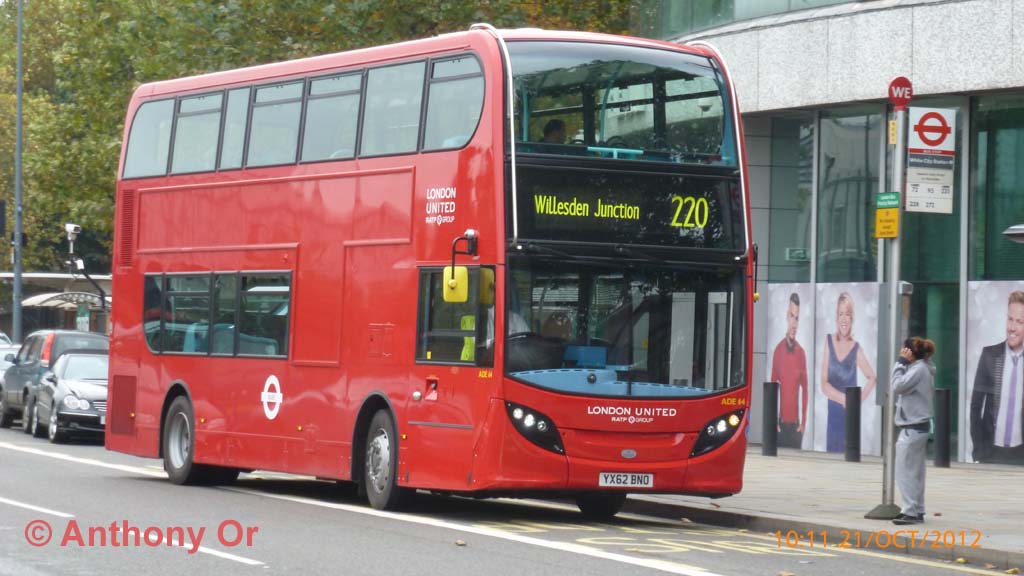
The 220 was the first London United route to gain low floor double deckers, with Alexander bodied Volvo B7TLs introduced in 2000. Some of those soldiered on until 2012, but then they were swept away overnight as the route was re-allocated to Park Royal garage using new Alexander Dennis Enviro400 double deckers. A couple of shots are provided, and first off is ADE64 (YX62 BNO) at White City on the second day, Sunday 21 October 2012, outside the now defunct BBC centre.
| Photo © Anthony Or. |
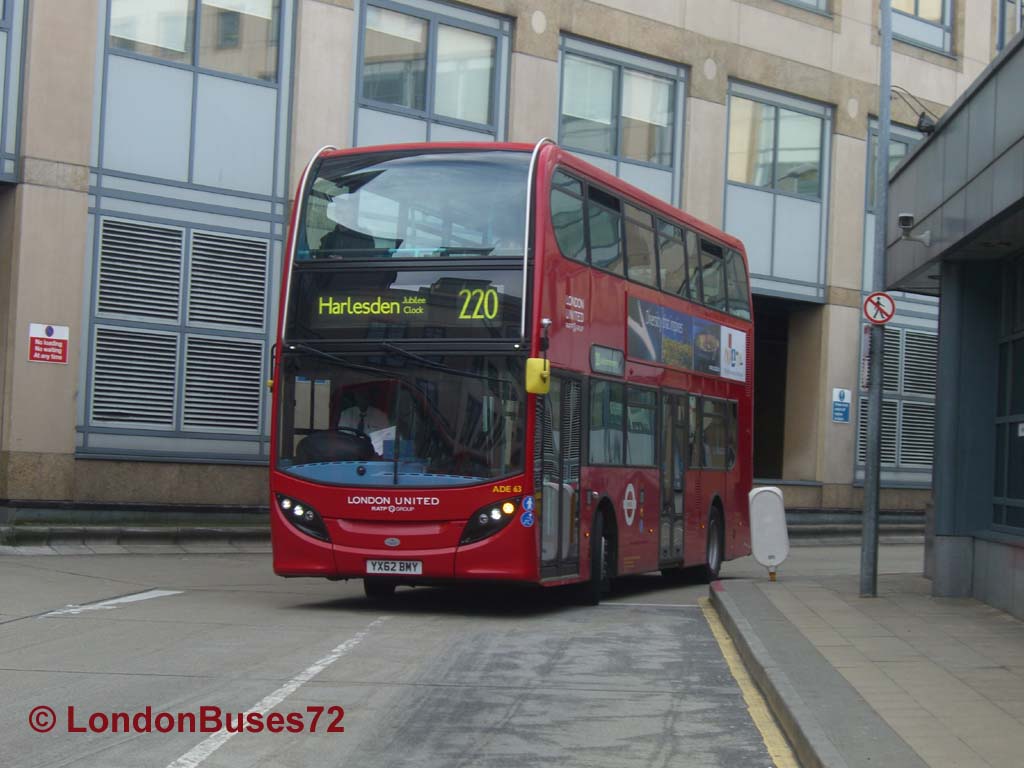
A second view is provided inside the "original" bus station at Hammersmith, also known as the upper bus station as it sits over the District Line platforms. This is sister vehicle ADE63 (YX62 BMY) on 17 April 2013. At this time the route was curtailed to Harlesden town centre due to the renovation of its normal terminal at Willesden Junction; the "Jubilee Clock" qualifier on the blind is not strictly accurate, because whilst the bus turns around at that well-known location, the last set down stop for passengers is at the Royal Oak, some distance earlier.
 | Photo © LondonBuses72. |
The 220 came into being by replacing most of the long 630 trolleybus, which ran from Croydon and Mitcham via Wandsworth and Hammersmith to Harlesden. This route also had variants numbered 626 and 628, which ran to Clapham Junction, and these had in turn replaced trams 30, 26 and 28 running over much the same roads. However, the Croydon - Mitcham leg of the 630 was replaced by extending route 64 (Addington - Croydon) (now covered by the 264). Subsequently the Mitcham - Wandsworth leg of the 220 became the 270.
The 220 is still kept busy, however. It is most useful between Putney and Shepherd’s Bush, but also provides the only service along Scrubs Lane in North Kensington. With the section to Wandsworth, the route allows a through journey right across inner West London.
Another significant historical point about the 220 is that it, together with route 95, was on 2 January 1971 host to the first DMS-class Daimler Fleetlines for London. (In 1971 the 95 ran from Cannon Street to Tooting. The service gradually petered out and was finally withdrawn in 1991, having largely been superseded by route 133.) The DMSs were very unreliable and so LT started withdrawing them prematurely. However, operators outside London which bought examples of what, to them, were modern buses, found that they had made excellent purchases once all the 'LT' specification features such as centre doors and safety interlocks had been removed!
Navigation
| Previous | Next | |
| Chronologically | 106 | 234 |
| Numerically | 215 | 221 |
Photo Gallery | Bus route list | Operational details | Service changes | Operators & Garages